
Keyword grouping has been around for a long time. It used to be done in Excel sheets, with SEOs using their judgement and search results to group relevant keywords into clusters. These groups give your website a more categorized look and help SEO specialists optimize the website for best performance.
These days there are tools that make this process a lot quicker and easier. In this guide, we'll explain exactly what keyword grouping is, why it's essential for your SEO strategy, and how to do it step-by-step using Optiwing's Keyword Grouper.

Basically, keyword grouping (or keyword clustering) is creating a list of semantically or search result related keywords that, once compiled, are distributed throughout pages in a manner that helps to drive paid or organic traffic.
For example, let's say you have two similar search queries - "learn stock trading" and "stock trading for beginners". Will you use them on the same page or on different pages of the site?
In order to answer this question, you would need to analyze competitors' search rankings and figure out whether the pages that rank for those keywords are the same or similar. This can take hours, if not days, to complete manually (again tipping the hat to Excel files). And still there is a big chance that the grouping is not done correctly.
There are a number of compelling reasons to use keyword grouping in your SEO strategy. Here are the key benefits:
Google's algorithms are smart and getting smarter constantly. Effective grouping helps your website appear more relevant to the search engine.
Use compact ad groups to improve CTR and get higher quality scores, saving money on acquiring paid traffic in PPC campaigns.
Keyword grouping helps enhance copywriting efforts and the quality of the content you are publishing on your site.
Avoid keyword cannibalization, structure your site correctly, and set the keywords you are targeting in your SEO efforts.
By automating keyword grouping, what takes hours or even days can be done in minutes, and also saves you from creating duplicate content.
Optiwing groups thousands of keywords in minutes using live Google SERP data. 100 free credits on signup, no credit card required.
Like any SEO strategy, keyword grouping has a series of steps to follow in order to get the best results.
Tools Needed: Ahrefs / SEMrush & Optiwing
Keyword grouping usually starts with collecting a large dataset of related keywords for a certain niche, including long-tail keywords. Use a keyword research tool to find a collection of keywords.
For example, we ran the keyword "Snowboard" through SEMrush's keyword magic tool.
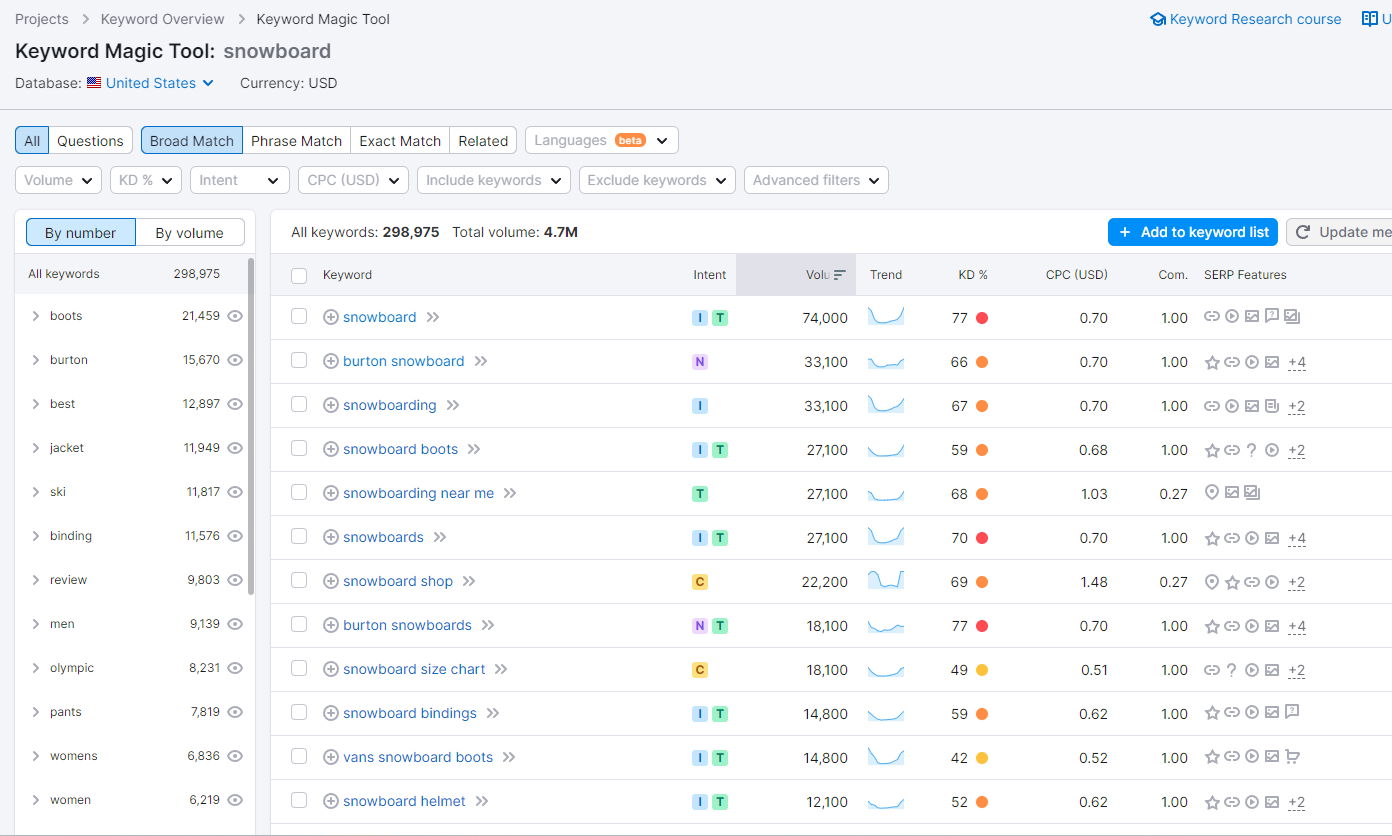
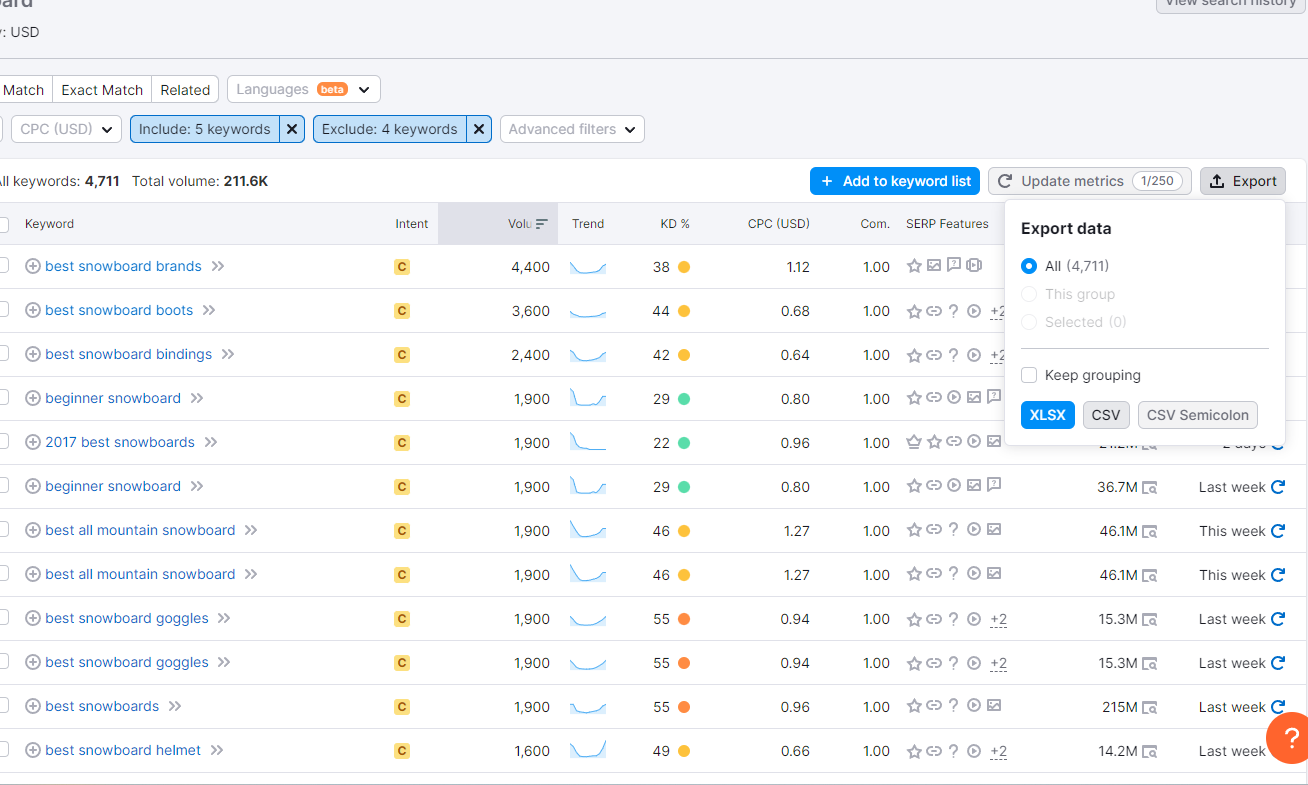
Once your keyword report is ready, click on "Broad Match" (or "Terms Match" on Ahrefs) to see all results with your seed keyword. We narrowed results by including "best", "top", "review", "reviews" and "beginner", and limited volume to above 20.
This narrowed our list down to 4,711 keywords, which we can use to create keyword groups for content optimization.
These groups have to be created around your main products or services. If you make and sell Snowboards, your high-level groups will be based on queries like "buy snowboard online", "new snowboards" and "best snowboards 2023."
We can use Optiwing to automatically group our keywords into clusters. This allows us to get an overview of which keywords are related to each other, based on live Google SERP data that Optiwing automatically gathers for each keyword. Just upload a CSV file of your keywords directly from SEMrush or Ahrefs, or create your own.
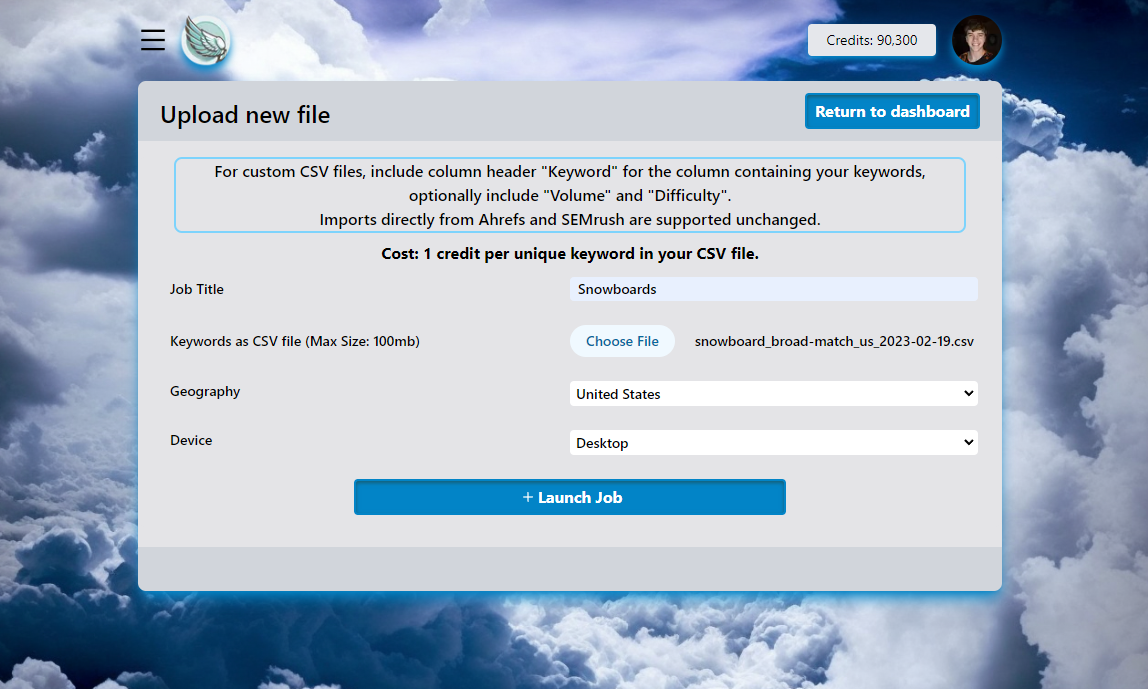
Then you can see which keywords can be targeted with a single article.
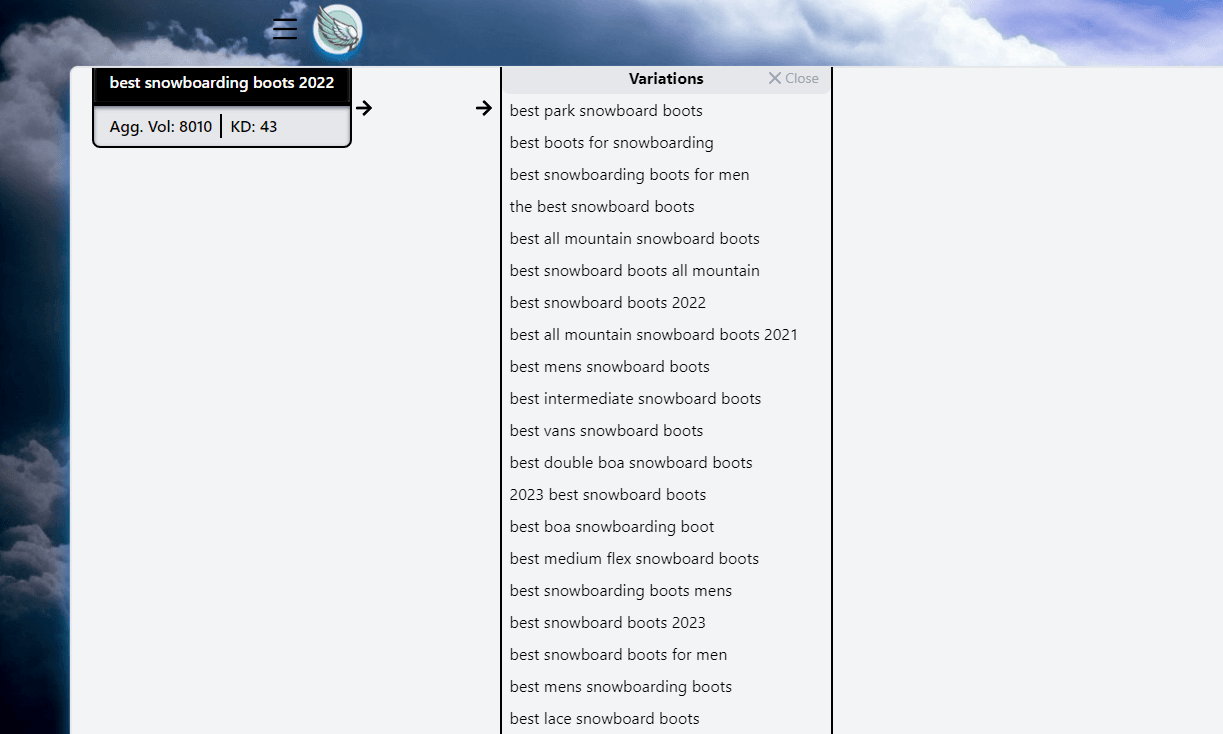
Repeat this process for long-tail keywords or other subsections of your niche to create additional secondary keyword groups.
These keyword groups can then be used in your content strategy to connect topically related pages. Whether you use Silo, Content Hubs, or a Pyramid linking structure, linking pages built around different keyword clusters can help drive organic traffic to related pages and create content to cover your niche in its entirety.
All the steps listed above might be intimidating to do manually. However, they can be easily automated using keyword research tools and Optiwing's keyword grouper.
The most accurate way to group keywords is by comparing their actual Google search results. Take your list of keywords, search each one on Google, and compare the top 10 ranking URLs — if two keywords share 3 or more of the same top 10 URLs, they share the same search intent and belong in the same group. Doing this by hand is slow, which is why an automated SERP-based grouper runs the searches and comparisons for you in minutes.

You can choose geolocation, device, and use any language you want.
Browse through your keyword list and highlight or save options using the following criteria:
These articles will bring more organic traffic than low-volume ones. Prioritize keywords with significant search volume.
Don't waste your time trying to challenge industry titans. A low keyword difficulty, paired with high volume searches, is often easier pickings.
Your chosen keyword must be relevant to your industry or niche. Relevance improves the user intent match for your content.
Understand how the article aligns with your business goals. Is it at the bottom of the marketing funnel or the top?
Ideally, you'd want to create articles for every keyword group. However, this can be expensive and time-consuming. So, prioritize keywords. If a keyword is high in volume, low in difficulty, relevant to your niche, and aligns with your business goals, it should be your initial target.
It's extremely important to group your semantic keywords correctly because it can tremendously affect the effectiveness and pace of your SEO efforts — now and in the future.
In order to avoid costly mistakes, we recommend manual and automated work when clustering if your topical core is not too large. For projects that require thousands of keywords, an efficient keyword grouping tool is an absolute must.
You can try Optiwing Keyword Grouper for free by creating an account, no credit card entry required. Keyword grouping credits start at $4.42 per 1000 keywords.
Keyword grouping (or clustering) is an SEO process where you group semantically-related keywords based on shared search intent, typically identified by analyzing overlapping search results (SERPs). This helps organize content, build topical authority, and target multiple keywords with a single piece of content.
SERP-based tools like Optiwing search each keyword on Google and compare the top ranking URLs. If two keywords share 3 or more of the same top 10 URLs, they likely share the same search intent and are grouped together. This is the most accurate method compared to NLP or lemmatization approaches.
Keyword grouping prevents keyword cannibalization, helps you structure your site correctly, ensures each page targets the right cluster of keywords, and saves you from creating duplicate or competing content. It also helps you build topical authority by covering related topics thoroughly.
Optiwing can handle thousands of keywords at once. You simply upload a CSV file (from tools like SEMrush, Ahrefs, Google Keyword Planner, or your own custom file) and the tool groups them automatically using live SERP data. Results are typically available within minutes.
For a small set of keywords, manual grouping in a spreadsheet works fine. Once you are dealing with hundreds or thousands of keywords, manual grouping becomes slow and error-prone, so automating it saves time and produces more consistent clusters. A good rule of thumb is to group manually when your topical core is small and automate when it is large. If you decide to automate, our comparison of 8 keyword grouping tools walks through the options.