
In the rapidly evolving world of Search Engine Optimization (SEO), AI keyword research is steadily becoming an essential tool for digital marketers. Harnessing the power of Artificial Intelligence for keyword research allows you to not only streamline your SEO efforts but also discover untapped opportunities, or "low hanging fruit" keywords, which can significantly boost your website's visibility.
One AI tool that has shown immense promise in this realm is ChatGPT, developed by OpenAI. As an advanced language model, ChatGPT can be leveraged to conduct thorough, intelligent keyword research. In this guide, we'll walk through how to use AI for keyword research and show you how Optiwing's AI-powered tools make the entire process even easier.

Traditional keyword research involves manually brainstorming seed keywords, plugging them into tools, and sifting through thousands of results. AI changes this dynamic by understanding context, intent, and language patterns far better than any manual process. Here are the key benefits of using AI in your keyword research workflow:
AI can generate dozens of keyword ideas in seconds, replacing hours of manual brainstorming and spreadsheet work. What used to take a day now takes minutes.
AI understands semantic relationships and can surface "low hanging fruit" keywords that traditional tools miss, including long-tail variations and related topics.
AI models like ChatGPT can analyze the intent behind keywords, helping you match content to what users actually want, whether informational, navigational, or transactional.
From a single seed keyword, AI can generate entire content clusters and topical maps, helping you build authority across your niche at scale.
Understanding your target audience's language and the keywords they use while searching online is crucial for successful SEO. This is where AI keyword research shines, especially when leveraging ChatGPT. ChatGPT is more than just an AI keyword research tool; it's an intelligent assistant that can help you find new, relevant keywords that your audience is actually using.
ChatGPT works by simulating human-like text conversations, making it an exceptional tool for understanding and predicting natural language patterns. It can generate realistic and relevant keyword suggestions based on input prompts. To utilize ChatGPT for keyword discovery, you can start by feeding it with some core keywords or topics related to your business. ChatGPT will then provide a list of related keywords, phrases, or questions that real users might use in their online search queries.
Start with your core product or service keywords. Ask ChatGPT to generate long-tail variations, related questions, and topical keywords your audience might search for. Be specific about your niche and target audience.
Refine your results by asking ChatGPT for more specific variations, such as question-based keywords, comparison queries, or buyer-intent keywords. Each follow-up can unlock new keyword angles.
Cross-reference AI suggestions with actual search volume data. Use a tool like Optiwing's Search Volume Checker to verify which keywords have real demand and assess their competition levels.
By utilizing this AI-powered workflow, you can significantly expand your keyword list, reach more potential customers, and enhance your overall SEO strategy.

Optiwing's Keyword Discovery tool uses AI to find untapped keyword opportunities for your niche. Get real search volume data instantly.
Let's look at some real-world examples of how to use ChatGPT for AI keyword research. These examples demonstrate the power of well-crafted prompts for simplifying keyword research.
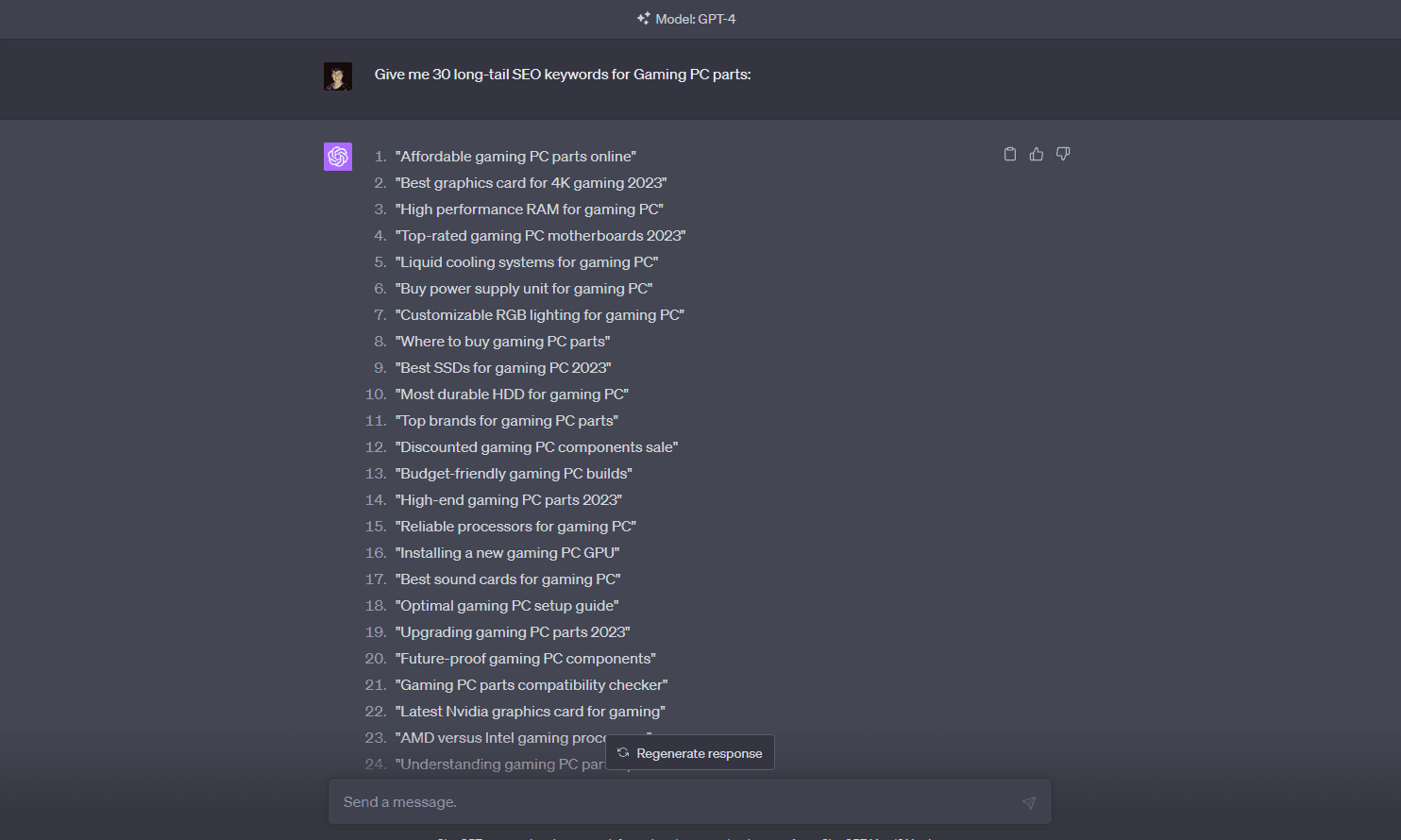
The AI model goes beyond traditional keyword tools that often merely suggest variations of input keywords. It's capable of understanding the context, thus coming up with a broader range of associated keywords. It's like having a brainstorming session with a team of expert content creators, only quicker and more efficient.
Moreover, with its ability to generate questions that people might ask on the topic, ChatGPT can be utilized to identify long-tail keywords — specific phrases with lower search volume but higher conversion rates. This method is often a goldmine for "low hanging fruit" keywords.
If you want to verify the search volume and interest of these keywords, you can add them into your favorite keyword research tool or use Optiwing's Search Volume Checker to verify the search volume and difficulty.

While ChatGPT is a powerful starting point for AI keyword research, purpose-built SEO tools take things further by combining AI intelligence with real search data. Optiwing offers a suite of AI-powered tools that streamline the entire keyword research and content creation workflow:
Uncover new keyword opportunities for your niche. Get suggestions with real search volume and difficulty data.
Generate comprehensive content briefs from your target keywords. Get outlines, headings, and SEO recommendations to guide your content creation.
Turn your keyword research into fully-written, SEO-optimized blog posts. Go from keyword to published content in minutes, not days.
Validate AI-generated keyword ideas with real search volume data. Check monthly volume, trends, and competition for any keyword list.
Optiwing's AI Content Brief tool transforms your target keywords into detailed, SEO-optimized content outlines. Start writing smarter, not harder.
Exploring fresh, engaging content topics is as crucial as discovering new keywords for your SEO strategy. It's about finding that sweet spot where your audience's interests intersect with your brand's offerings. Here, ChatGPT can be a game-changer, assisting you in unearthing unique and relevant topics that resonate with your target audience.
This is important for SEO to fully cover the topic and build topical authority in your niche. When you cover a topic in its entirety, not only do you have lots of relevant content for users, but it also gives you a boost in the rankings for becoming an authority on the subject. One way to do this is asking for related topics and keywords to your niche.
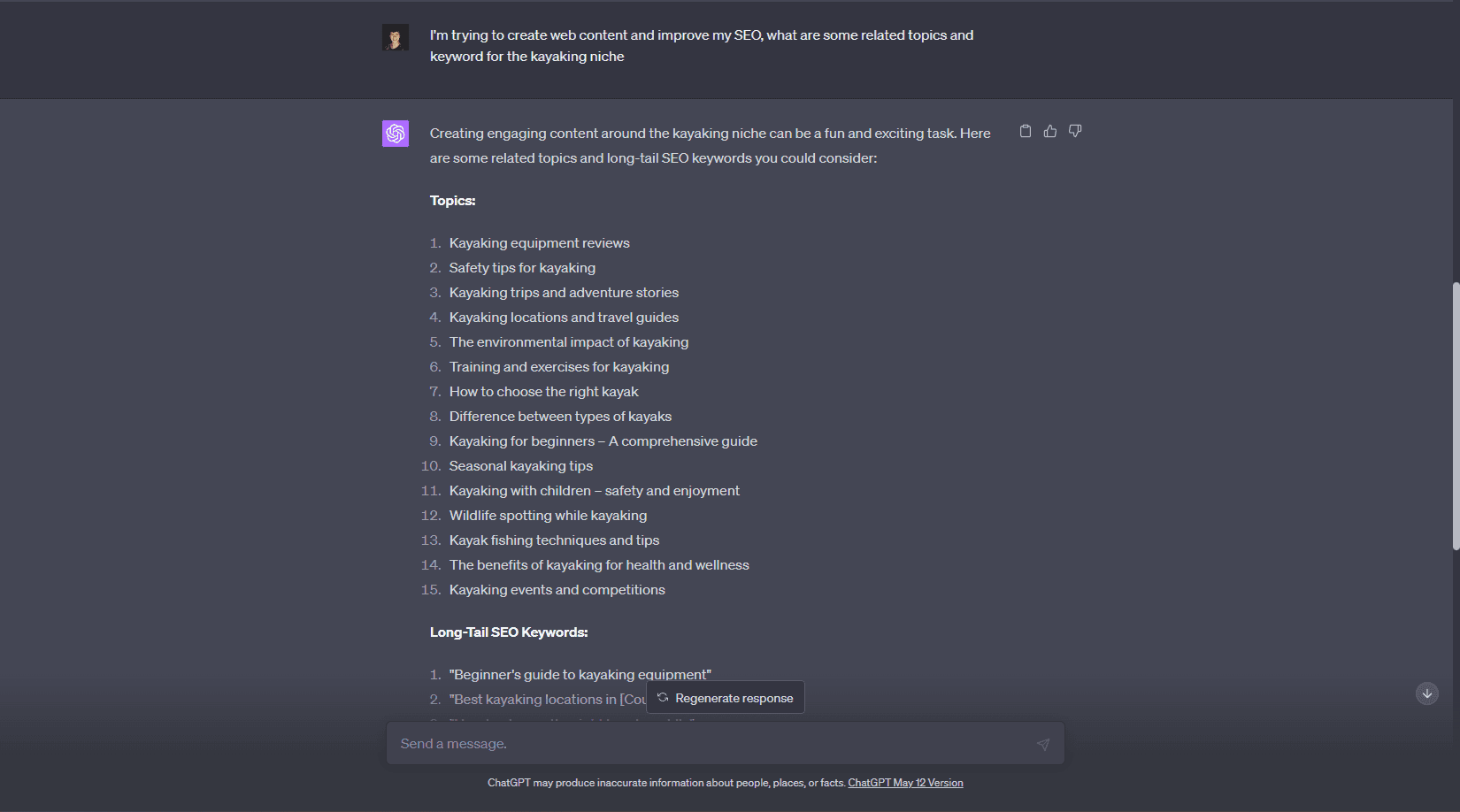
ChatGPT's strength lies in its ability to generate topics that are not merely variations of the input keyword but instead widen the content scope, potentially reaching a broader audience. The AI model can also suggest unique angles to approach existing topics, enabling you to create content that stands out.
Furthermore, using the questions generated by ChatGPT can also provide new perspectives and topic ideas. These questions, which the AI predicts users might ask about a particular topic, can guide the creation of comprehensive, SEO-friendly content like blog posts, FAQ pages, or even a series of social media posts.
Once you have your related keywords, you can use Optiwing's Keyword Grouping tool to automatically cluster them by search intent using live SERP data. This tells you which keywords can be targeted with a single page and which need separate content, saving you from keyword cannibalization.
The real power of AI keyword research isn't just finding keywords — it's turning those keywords into high-quality content that ranks. Here's how to build an end-to-end AI-powered SEO workflow:
Use ChatGPT or Optiwing's Keyword Discovery tool to generate a comprehensive list of keyword ideas for your niche. Focus on long-tail keywords with clear search intent.
Check your keyword list against real data using a Search Volume Checker. Prioritize keywords with decent volume and manageable difficulty.
Use keyword grouping to cluster related keywords together. This prevents cannibalization and ensures each page targets a complete keyword cluster.
For each keyword group, create a content brief that outlines the structure, headings, and key points to cover. This ensures your content is comprehensive and SEO-optimized from the start.
Use Optiwing's AI Blogpost Writer to turn your briefs into fully-written, SEO-optimized articles. Review, refine, and publish content at scale.
In essence, AI is a powerful ally for keyword research that can function like having an extra SEO professional on your team. Whether you use ChatGPT directly or leverage purpose-built tools, AI dramatically reduces the time and effort required to discover, validate, and act on keyword opportunities.
The questions and topic ideas generated by AI can guide the creation of comprehensive, SEO-friendly content like blog posts, FAQ pages, and social media content. Combined with real search data from tools like Optiwing, you get the best of both worlds: AI creativity and data-driven accuracy.
Ready to supercharge your keyword research? Try Optiwing's AI-powered tools for free — create an account with no credit card required and start discovering keywords, generating content briefs, and writing optimized blog posts today.
AI keyword research is the process of using artificial intelligence tools like ChatGPT or dedicated AI-powered SEO platforms to discover, analyze, and prioritize keywords for your SEO strategy. Unlike traditional tools that rely on database lookups, AI can understand context, generate creative keyword ideas, and identify semantic relationships between topics.
ChatGPT is excellent for brainstorming and generating keyword ideas, but it cannot provide real search volume or difficulty data on its own. The best approach is to combine AI-generated ideas with data from tools like Optiwing's Search Volume Checker to validate which keywords are worth targeting.
Popular AI tools for keyword research include ChatGPT for brainstorming, and purpose-built platforms like Optiwing's Keyword Discovery tool which combines AI with real search data. Optiwing also offers AI Content Briefs and an AI Blogpost Writer to take you from keyword discovery to published content.
Ask AI to generate long-tail keyword variations for your niche, then validate them with search volume data. Look for keywords with decent monthly searches (50-500+) but low competition. These often have clear, specific search intent and are easier to rank for. Optiwing's Keyword Discovery tool can surface these opportunities automatically.
The most effective workflow is: (1) discover keywords with AI, (2) validate with real search data, (3) group keywords by intent using keyword grouping, (4) generate content briefs, and (5) write or assist content creation with an AI writing tool. This end-to-end approach ensures your content is both data-driven and optimized for search.
AI is excellent at generating creative keyword ideas and understanding semantic relationships, but it does not inherently know real-time search volumes. That's why it's important to validate AI suggestions with actual data. Tools like Optiwing bridge this gap by combining AI intelligence with live search engine data, giving you both creativity and accuracy in your keyword research.